
Clinton County Criminal Court Cases
Clinton County criminal court cases can begin in any of three Magisterial District Courts. MDJ 25-3-01 serves the Lock Haven district, MDJ 25-3-02 serves the Mill Hall district, and MDJ 25-3-03 serves the Renovo district. These courts handle preliminary arraignments, bail, warrants, preliminary hearings, and summary matters. A felony or misdemeanor that is held for court moves to the Court of Common Pleas of Clinton County, the county's 25th Judicial District. Summary cases usually stay at the MDJ level unless appealed.
The Clerk of Courts maintains the Common Pleas criminal file. Its docket format is CP-18-CR-sequence-year, with 18 as Clinton County's code. The District Attorney files the criminal information after the preliminary stage. From then on, motions, calendar events, pleas, verdicts, sentencing orders, and payment entries build the court record. That file answers a different question from a police report or jail booking. The Clinton County arrest lookup explains those earlier agency records.
Clinton County MDJ Case Handoff
“Held for court” is a key Clinton County docket phrase. It means the MDJ found that the prosecution may proceed after a preliminary hearing or waiver. It does not mean a conviction. The complaint and early MDJ docket identify the first allegations, bail decision, and preliminary events. Once transferred, the Common Pleas file receives a new CP-18 number, and the filed criminal information may differ from the first police charges.
Search both court levels when tracing one prosecution. Match the defendant name cautiously, then compare the offense tracking number, police complaint number, filing dates, originating MDJ, and arresting agency. A name alone may identify the wrong person. The handoff is also why an early charge shown in a police release can differ from the counts that reach plea, trial, or disposition in Clinton County.
Searching Clinton County Case Records
The free UJS Public Web Docket Sheets search is the broadest first stop for Clinton County criminal court cases. It needs no public account and covers both Common Pleas and Magisterial District Court dockets. Exact docket numbers work best. Participant names, organizations, offense tracking numbers, police incident or complaint numbers, and state identification numbers are available in supported searches. The county filter helps keep results focused on Clinton County.
- Open Public Web Docket Sheets and select Criminal Courts of Common Pleas or Magisterial District Courts.
- Enter the full docket number when known. Otherwise, use a participant name or another supported identifier.
- Select Clinton County and narrow by filing date or court level when the controls permit it.
- Open the PDF docket and compare general information, charges, calendar, entries, disposition, sentence, and finances.
- Ask the Clerk for a pleading, order, certified copy, or older Clinton County file that the public PDF does not contain.
| Field Label | Type | Required | Notes |
|---|---|---|---|
| Search Type | Tabs or dropdown | Yes | Choose Common Pleas or Magisterial District Court. |
| Search By | Dropdown or tabs | Yes | Docket, participant, organization, OTN, complaint number, or SID where supported. |
| County | Dropdown | No | Select Clinton to narrow the result set. |
| Docket Number | Text components | Conditional | Use exact CP-18 or MDJ components when known. |
| Participant Name | Text | Conditional | First name narrows a common surname; verify every match. |
| Filing Range | Date controls | No | Availability changes with the selected search. |
The official guide recommends a current browser and working PDF pop-ups. Secure docket services contain material reserved for approved users, while the public search supplies the public docket sheet. Limited-access cases are removed from the public view.
The UJS search interface is shown in this official-source capture.
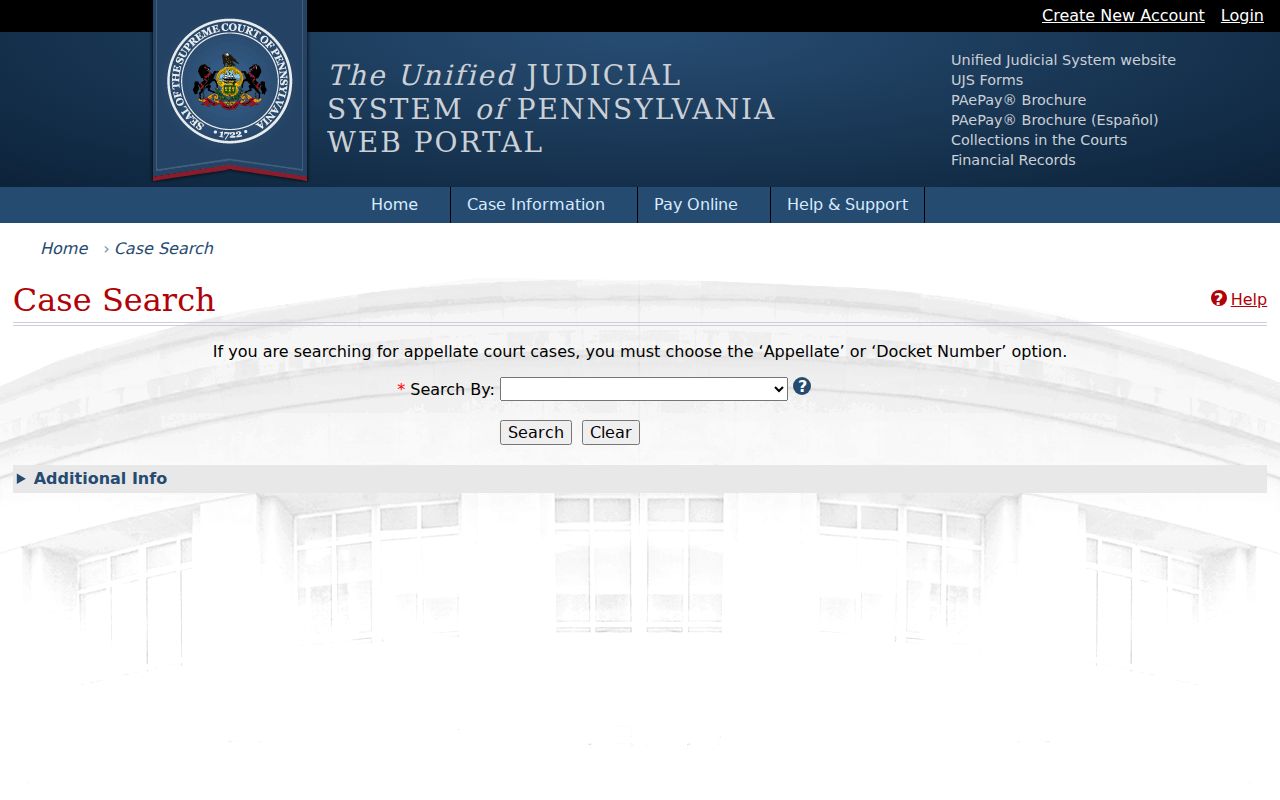
Its court-level and identifier choices help distinguish an early MDJ docket from the later Common Pleas case.
Clinton County PAeDocket Options
The UJS portal also points users to the free PAeDocket mobile app. It can search by case number, participant, organization, offense tracking number, police incident or complaint number, or SID where supported. That choice is useful when a Clinton County search starts with a citation or police document instead of a court docket number.
A mobile result remains a docket summary. It does not replace a signed order, the criminal information, or a certified disposition from the Clerk. Review each charge line and its outcome rather than treating the case status header as the whole result. Bail, calendar, and financial blocks answer separate questions, and some entries are visible only to secure users.
The official UJS portal overview documents the available search methods and PAeDocket.
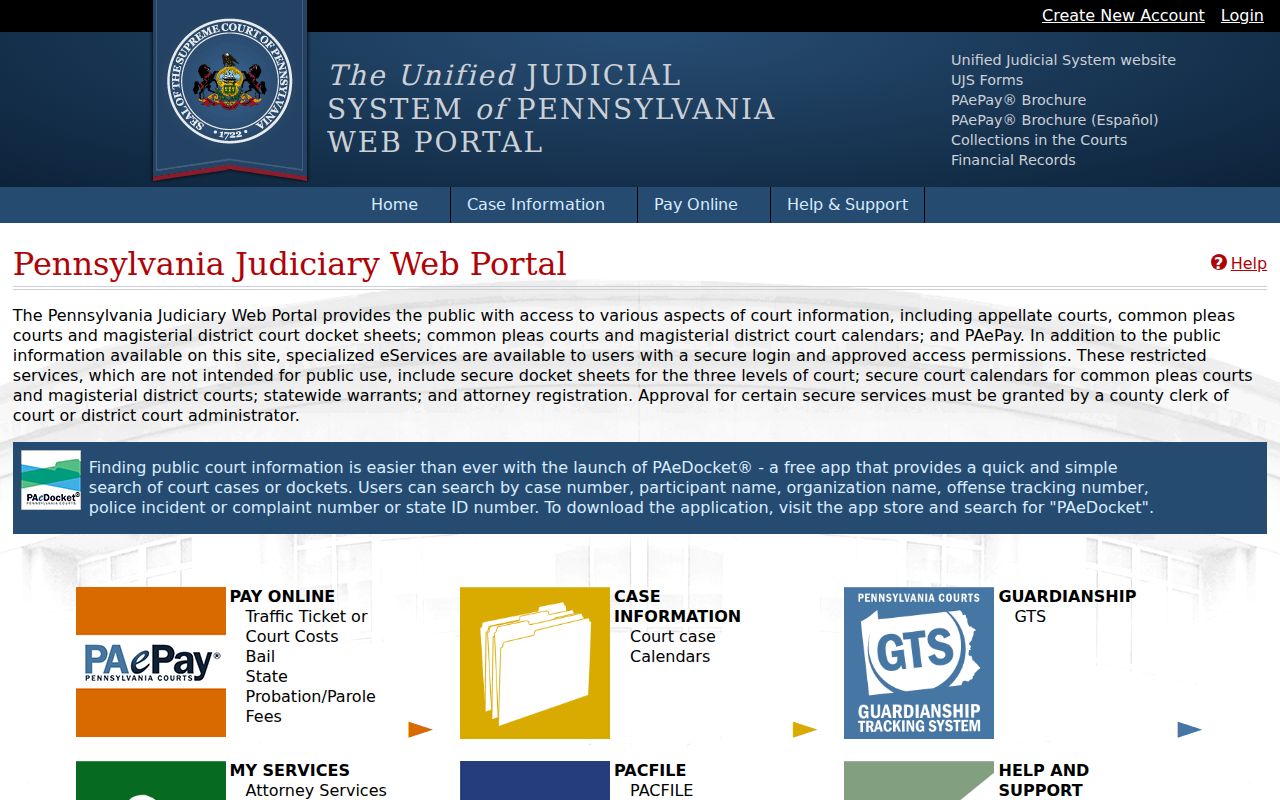
This second channel is convenient for tracking a case, but the Clinton County Clerk remains the source for certified court documents.
Inside a Clinton County Case File
A Clinton County docket organizes one prosecution rather than a person's full criminal history. Its header links the court, docket, OTN, status, filing date, judge, originating MDJ, and arresting agency. The charge grid then shows each count, statute, grade, and disposition. Filings and orders form a dated history, while the sentence and financial blocks record what happened after a guilty outcome.
| Case Number and Court | Identifies the CP-18 or MDJ docket, Clinton County court level, status, filing date, and assigned judge. |
|---|---|
| Charging Documents | The complaint starts allegations; the District Attorney's information states Common Pleas charges. |
| Docket Entries | Dates complaints, hearings, informations, motions, orders, pleas, verdicts, sentence, and appeals. |
| Bail and Calendar | Lists bail type, amount, status, surety data, court events, time, judge, and courtroom when public. |
| Disposition | Gives the charge-level result, such as conviction, dismissal, acquittal, or nolle prosequi. |
| Sentence and Finances | May show confinement, probation, restitution, fines, costs, payments, and balance. |
F1, F2, and F3 mean felony grades; M1, M2, and M3 mean misdemeanor grades; S marks a summary offense. “Nolle prosequi” means the prosecutor formally chose not to continue that charge under court procedure. Read the grade and disposition together. A filed charge is not itself the final result.
Clinton County Certified Case Copies
UJS provides a free summary, but it is not a document repository. The combined Prothonotary and Clerk of Courts office holds Clinton County criminal files dating to the county's creation in 1839. The Clerk can address requests for pleadings, orders, certified dispositions, and older material. Staff maintain files and collect fees, but they cannot decide eligibility or give legal advice.
Clinton County Clerk of Courts
230 East Water Street
Lock Haven, PA 17745
570-893-4007
Monday, Tuesday, Thursday, Friday: 8 a.m. to 5 p.m.
Wednesday: 8 a.m. to 12:30 p.m.
Current county fees are $0.50 per copied page and $5.50 for certification. A summary appeal is listed at $47.50. Ask about retrieval time and the full charge before ordering an older or large file. The county's fee-based Infocon access includes Clerk docket data and scans among more than 200,000 county documents, which can add source documents that a UJS PDF does not show.
Note: Wednesday's early closing can affect in-person Clinton County court record requests, so confirm counter hours before travel.
How a Clinton County Case Moves
A complaint starts the judicial trail. An MDJ conducts a prompt preliminary arraignment and addresses bail. The preliminary hearing, or its waiver, tests whether the matter goes forward. If held for court, the Clerk receives the case and the District Attorney files an information. Formal arraignment, pretrial motions and calls, a plea or trial, disposition, sentence, and possible appeal follow. The county calendar separately lists arraignments, Criminal Call, jury selection, and specialty-court dates.
Case flow: Charges Filed › Arraignment › Pretrial › Plea or Trial › Disposition › Sentencing
A summary matter follows a shorter route at the MDJ unless appealed to Common Pleas. A docket can also show continuances, motions, and orders between the main steps. Those entries explain why two Clinton County cases filed close together may move on different schedules.
Clinton County Specialty Court Paths
Some Clinton County criminal court cases follow a structured specialty track. Behavioral Health Court began in 2020. Treatment Court uses long-term, close supervision, with at least one year of active participation and one year of aftercare within a program described as lasting at least three years. Veterans Treatment Court began locally in 2016 and later grew into an eight-county regional model.
These programs do not erase the court file merely because a participant enters supervision. Applications and judicial events still belong to the case path, subject to public-access restrictions. Specialty Courts is based at the courthouse and can be reached at 570-893-4051. The county specialty-courts page provides the official program context.
Historic Clinton County Court Files
Clinton County's combined Clerk and Prothonotary office reports civil and criminal holdings back to 1839. That history reaches far beyond a modern web index. The first county court met at Barker's Tavern, and the current courthouse was dedicated in 1869. Older case research may therefore require a direct Clerk inquiry even when a participant-name search returns nothing online.
Give staff the closest known name, year, court level, and docket reference. Ask whether the file is indexed, where it is stored, what retrieval delay applies, and whether a plain or certified copy is needed. Infocon's paid scans may help with some local documents, but the archive and Clerk remain the sound fallback for historic Clinton County criminal court records.
Clinton County Case Access Restrictions
Pennsylvania's UJS Case Records Public Access Policy governs judicial files. It supports public docket access while shielding Social Security numbers, financial accounts, driver-license and SID data, protected minor and victim information, and confidential documents. Juvenile, sealed, expunged, and limited-access cases receive added protection. A public terminal or online PDF may therefore show less than an authorized court user sees.
Do not route every court question through the county's general Right-to-Know officer. Ordinary docket and copy requests go first to the Clerk. Judicial administrative requests use the court's designated officers. The Pennsylvania Right-to-Know Law governs agency records, but it does not replace the judiciary's access policy or make police investigative files part of a Clinton County court case.