
Checking Criminal History in Lock Haven
Begin with the record closest to the event. Lock Haven Police keeps accident, citation, criminal-case, arrest, evidence, and incident material created by its officers. A detention creates a separate Clinton County Correctional Facility entry, while a filed complaint creates a Magisterial District Judge docket. If the charge is held for court, the Clerk of Courts maintains the later Common Pleas file. PSP may also receive fingerprint-linked data for a reportable offense.
Use a short chain that preserves names, dates, and agency numbers across each stop:
- Ask Lock Haven Police for the incident or arrest record and keep the incident number.
- Use the city Right-to-Know form when routine counter release does not fit the request.
- Check MDJ 25-3-01 and the UJS portal for the first filed case.
- Check county booking and Common Pleas sources if custody or trial-level charges followed.
- For your own full repository record, use the PSP access-and-review process rather than treating a public post as complete.
The county-wide criminal court case search explains the UJS and Clerk channels in more depth. Keep the city request narrow so the police records staff can identify the exact file.
Three Lock Haven Record Stops
One Lock Haven arrest can leave records in three places several miles apart. Police headquarters on East Church Street holds the city report. MDJ 25-3-01 on Frederick Street handles the first judicial events. If detention occurs, booking is at McElhattan, not at a city jail. Later Common Pleas records are kept at the courthouse on Water Street.
| Question | Start here | Record |
|---|---|---|
| What did city police document? | Lock Haven Police | Incident or arrest report |
| What was filed first? | MDJ 25-3-01 | Preliminary docket |
| Was the person held? | County jail | Current detainee entry |
| What was the final case result? | Clerk or UJS | Common Pleas docket |
This split prevents a common mistake. A police post describes agency action at one point in time. It does not prove that every allegation reached court or remained unchanged.
Lock Haven Police Department Records
The Lock Haven Police Department provides round-the-clock police coverage from 20 East Church Street. Its records contact is 570-893-5911 and police@lockhavenpa.gov. The city identifies a force of 12 uniformed and four nonuniform personnel. Its records function processes accidents, citations, criminal cases, arrests, and evidence-related records. Call before assuming a document is ready or publicly releasable.
The official city police records source shows the department channel used for these requests.
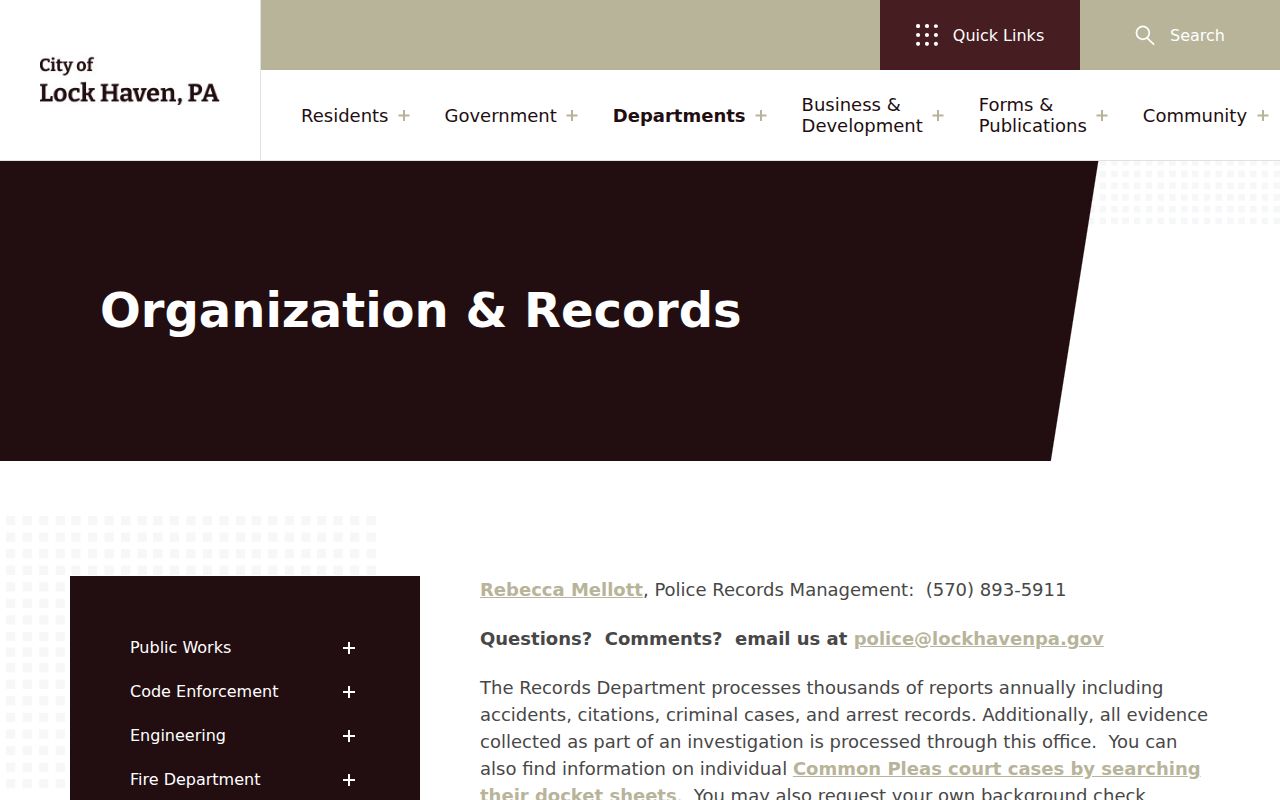
The records page connects a Lock Haven request to the agency that created the report, while court dispositions remain with the judicial offices.
Lock Haven Police Department
20 E. Church St.
Lock Haven, PA 17745
570-893-5911
police@lockhavenpa.gov
24-hour police coverage
Lock Haven Police Record Requests
The online city Right-to-Know request asks for first and last name, email, phone, street, city, state, ZIP, and a specific description. The narrative should include dates, subjects, names, and other identifiers that point to one set of records. Separate required choices ask whether the requester wants copies, inspection, or certified copies. That distinction lets someone ask to inspect material without automatically requesting delivery.
The official Lock Haven RTK form also includes acknowledgments concerning United States residency and truthfulness.
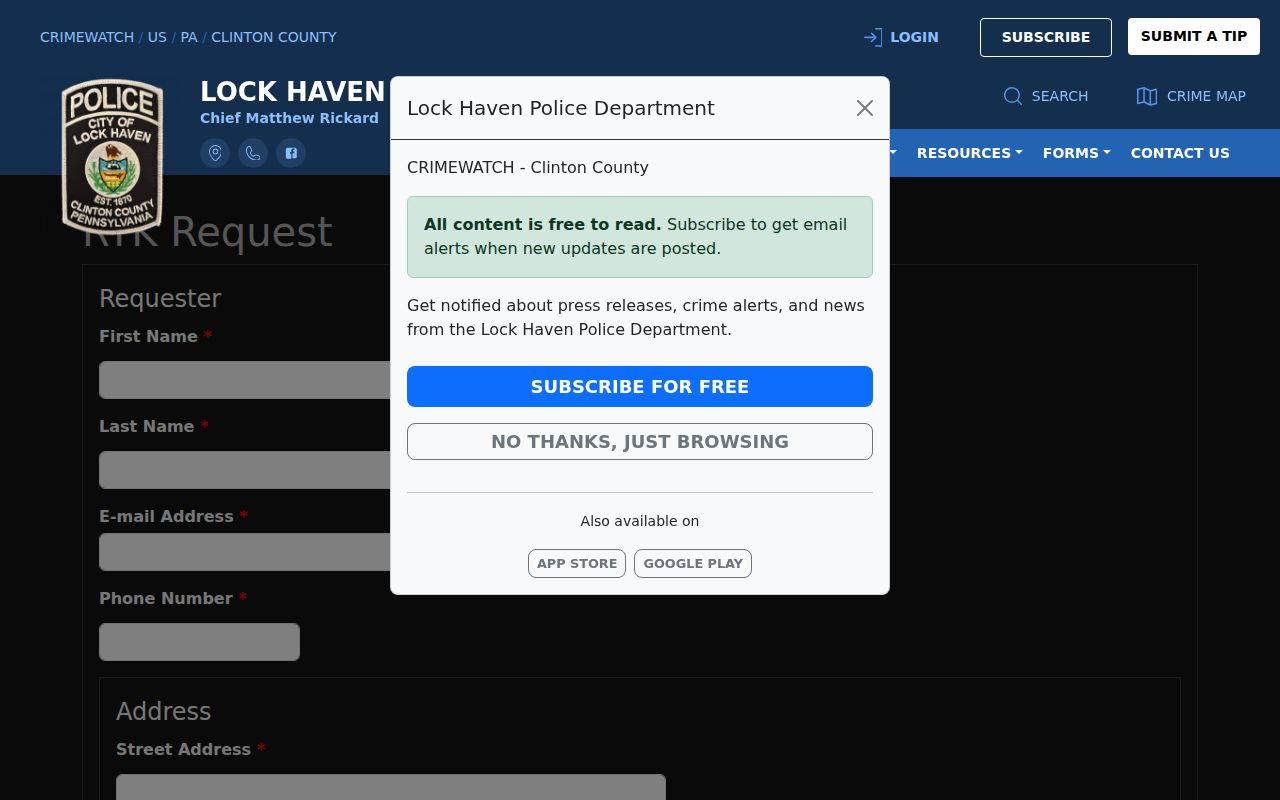
The form does not post a universal charge or response time. Ask the city about cost and delivery for the specific format instead of relying on an assumed fee.
Lock Haven Arrests and Bookings
A Lock Haven officer creates an agency narrative. If a person is detained, Clinton County creates the booking record at its McElhattan facility. The county's downloadable current-detainee PDF is narrow: it lists a name and seven-digit booking number as of a stated time. It has no public photo, charges, bond, arresting agency, or court date. The file is therefore a custody check, not a complete Lock Haven arrest history.
CRIMEWATCH can publish Lock Haven arrests, cases, incidents, and warrants. Those entries may help identify a date or agency number, yet the feed is not comprehensive. A fuller recent-arrest path uses the city report, county custody list, and court docket together. The Clinton County arrest lookup covers the jail phone and statewide custody options.
Lock Haven CRIMEWATCH Posts
The official Lock Haven CRIMEWATCH area offers Most Recent, Incidents, Cases, Warrants, Arrests, News, Broadcasts, and Events views. Readers can subscribe to alerts or use the CRIMEWATCH app for new agency notices. This is useful when the question is whether the department publicly described a recent event.
A post is still a publication, not the whole investigative file. It may predate amendment, withdrawal, a plea, trial, or dismissal. Search UJS by the cited name or docket details, then compare the charge-level result. If the post itself appears wrong, contact the publishing police agency; a later court result does not automatically rewrite an old news entry.
Municipal Court Records in Lock Haven
Lock Haven has no separate municipal criminal court. MDJ 25-3-01 is the correct first court at 301 Frederick Street, Suite 100, Lock Haven, with telephone 570-893-4086. It handles summary cases, preliminary arraignments and hearings, bail, and warrants. A felony or misdemeanor held for court moves to the Court of Common Pleas and Clerk at the Water Street courthouse.
| Court Name | Magisterial District Court 25-3-01 |
|---|---|
| Case Types Heard | Summary matters, preliminary criminal proceedings, bail, and warrants |
| Case Lookup Channel | UJS Public Web Docket Sheets, PAeDocket, telephone, or clerk counter |
| What the Docket Shows | Charges, events, bail, participants, status, and disposition entries available to the public |
| Copies and Fees | No local MDJ copy schedule was documented; call before travel |
Do not search for a “Lock Haven Municipal Court.” That label hides the actual Pennsylvania court structure and can send a request to the wrong office.
Lock Haven Cases Moving Forward
The MDJ docket records the early phase. It may show a complaint, preliminary arraignment, bail decision, hearing, and whether charges were held for court. Common Pleas then uses a docket in the form CP-18-CR-sequence-year. The later file can add the criminal information, formal arraignment, motions, plea or trial, sentence, financial entries, and appeal activity.
Case route: Lock Haven Police › MDJ 25-3-01 › Clinton County Clerk of Courts.
Search both levels. Two docket numbers can describe successive stages of one prosecution, not two unrelated Lock Haven cases. Summary cases normally remain at the MDJ level unless appealed.
Where Lock Haven Records Go
Police, jail, court, and repository records answer different questions. A reportable Lock Haven arrest can send fingerprints and identifiers to the Pennsylvania State Police Central Repository. Judicial outcomes should later connect to that arrest cycle, but reporting lag or mismatched identifiers can create gaps. PATCH is a Pennsylvania repository search, while UJS is a case search.
Record flow: Lock Haven Police › Clinton County Courts › Pennsylvania State Police Central Repository.
Someone reviewing their own record should compare the PSP access-and-review response with the Clerk and UJS docket. That approach is stronger than treating the city post, jail list, or public PATCH certificate as interchangeable.
Lock Haven Crime Record Statistics
Use the Pennsylvania UCR system under the reporting-agency name Lock Haven City Police Department. Retain the chosen year and report settings when citing a result. CRIMEWATCH post counts are not crime rates, and a busy month of agency news cannot support a claim that a part of Lock Haven is unsafe.
The 2020 Census counted 8,108 Lock Haven residents, making it Clinton County's largest incorporated place and its only incorporated city. Its role as the county seat helps explain why city police, the MDJ, Clerk, Sheriff, and county court channels sit close in the justice core, even though booking occurs outside Lock Haven.
UCR data is grouped by reporting agency and year. It does not replace a Lock Haven incident report, identify the outcome of a named case, or prove that every event in the city was investigated by the same department. Preserve the agency selection, year, and offense table when using a figure. Compare like periods and avoid turning a count into a claim about one person, street, or neighborhood. For an individual event, return to police and court records.
Lock Haven Police Initiatives
Lock Haven Police participates in regional narcotics work and Buckle Up PA activity. The Commonwealth announced a $14,000 Act 120 training reimbursement in January 2025, and PCCD awarded $153,668 for the Clinton County Tasers Project through Lock Haven City in September 2024. These are useful institutional facts, not proof of a change in record access.
The distinction matters. Grants and training can shape staffing or equipment, but they do not replace the city request form, Pennsylvania Right-to-Know Law, or court public-access rules. Requesters should still use the custodian tied to the desired Lock Haven document.
Public Access Rules in Lock Haven
The Pennsylvania Right-to-Know Law governs requests for many city records, but police investigative records may be exempt. Judicial records follow the Unified Judicial System Public Access Policy instead of the ordinary city route. Juvenile material, confidential information, victim contact data, Social Security numbers, financial accounts, and sealed, expunged, or limited-access matters are restricted.
Key Statutes:
Pennsylvania Right-to-Know Law sets the request and appeal framework for covered public records.
18 Pa.C.S. Chapter 91 controls criminal-history collection and dissemination.
UJS Public Access Policy governs access and redaction for Pennsylvania judicial case records.
Describe a record precisely and send it to the correct custodian. A denial should identify the basis and appeal route. Public access does not mean that each Lock Haven agency owns every part of an arrest or prosecution.
Correcting Lock Haven Criminal Records
A mismatch should be sent to the office that owns the disputed entry. Lock Haven Police can address its report or CRIMEWATCH publication. MDJ 25-3-01 and the Clinton County Clerk maintain their own docket data. PSP controls a Pennsylvania repository history. One office cannot simply rewrite the others' records.
For your own record, obtain PSP access and review, then compare it with the UJS docket and certified court outcome. Keep the OTN, police complaint number, MDJ docket, Common Pleas docket, and exact charge disposition together. Those identifiers connect the stages of a Lock Haven arrest more reliably than a name alone. A missing outcome can result from reporting lag or a mismatch in identifying data. Send the final disposition to the proper holder and use its correction or challenge process.
Some gaps are intentional. Juvenile, sealed, expunged, and limited-access records may be absent from an ordinary public view. A current detainee may also disappear from the jail PDF after release even though the court case remains. Check the source's scope before treating an absence as an error.
Resolving Lock Haven Warrant Records
A Lock Haven warrant may appear in a police CRIMEWATCH post, the Clinton County Sheriff's warrant material, an Adult Probation bench-warrant resource, or the underlying UJS docket. None should be described as a guaranteed statewide, real-time search. An old post can remain visible after court action, and no online result proves that no warrant exists.
For your own possible warrant, call the issuing court or Sheriff for current instructions. MDJ 25-3-01 handles warrants in its cases, while the Sheriff serves Common Pleas bench warrants. The Sheriff's office can be reached at 570-893-4070. In October 2025, a Safe Surrender courthouse event offered a route to address bench warrants, court contact, payment plans, and possible warrant vacation. That past event illustrates the need to seek current court directions rather than act on stale web material.